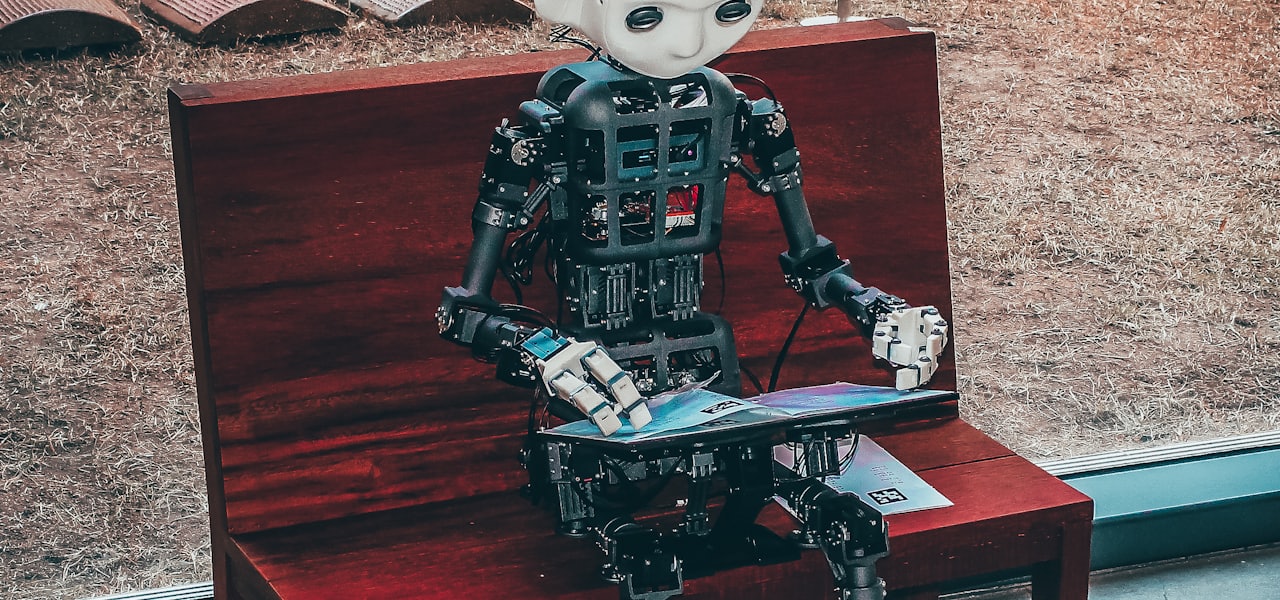
H Company, also known simply as H, is a French artificial intelligence startup which develops "action-oriented" artificial intelligence agents for enterprise automation and productivity. In May 2024, H Company closed a record-setting $220 million seed round, at the time the largest AI raise in Europe. In 2026, H Company released Holo 3, the latest generation of its computer-use AI models. The update marked a major advance in agentic AI, enabling agents to navigate any user interface, interpret screens, and complete complex, multi-step tasks across enterprise systems—much like a human user. This breakthrough positioned H Company at the frontier of computer-use autonomy, accelerating the integration of AI in enterprise workflows. == History == H Company was founded in 2023 in Paris by Laurent Sifre, Charles Kantor, and three DeepMind veterans: Daan Wiestra, Karl Tuyls, Julien Perollat. In May 2024, the firm secured what was then the largest European AI seed round, totaling $220 million led by US investors including Eric Schmidt (former Google CEO), Amazon, and backed by Accel, Bpifrance, UiPath, Eurazeo, Xavier Niel, Yuri Milner, Bernard Arnault, Samsung and others. In August 2024, three cofounders (Wiestra, Tuyls, Perollat) left the company over operational disagreements. In November 2024, H launched Runner H, its first agentic-API platform, which combined a large language model (LLM) and a reduced, 2-billion parameter vision-language model (VLM). In May 2025, H Company acquired Mithril Security, and in June 2025 the company widened its offering for agentic models. In June 2025, Gautier Cloix (formerly CEO Palantir France) replaced Charles Kantor as CEO of H Company, aiming to pivot the company towards a "forward deployed engineers" model. In July 2025, H Company introduced Surfer-H-CLI, an open-source, web-native Chrome agent designed for browser-based automation—able to search, scroll, click, and type on behalf of users and controllable via any visual language model (VLM). When paired with its June 2025 open-sourced 3B-parameter Holo-1 model, Surfer-H-CLI achieved 92.2% WebVoyager benchmark accuracy. == Activity == H Company creates enterprise AI models and agents (agentic AI) to automate and optimize complex workflows. H Company specifically designs AI agents called computer use capable of autonomously interfacing with any software (local or cloud-based) to detect and automate repetitive operations. H Company is based in Paris, France, with international offices in London and New York. H Company raised $220 million since its inception. Gautier Cloix is president and CEO of the company. H Company client include the French national lottery FDJ United. In March 2026, H Company released Holo3, a family of artificial intelligence models designed to operate digital systems by interacting directly with user interfaces. Holo3 enables agents ("virtual humanoids") to understand what is displayed in front-end environments—such as web pages, desktop applications, and other graphical user interfaces—and perform actions such as clicking, typing, and navigating across them to complete multi-step tasks. On the OSWorld-Verified benchmark, Holo3 reportedly achieved about 78.9%, surpassing the scores of OpenAI’s GPT‑5.4 and Anthropic’s Claude Opus 4.6 on this specific test, at roughly one-tenth of the inference cost of these proprietary systems. The release has been presented as a significant step toward automating routine digital workflows, allowing organizations to offload repetitive on-screen work, such as data entry and reconciliation across multiple tools, to AI-based agents.
Hidden layer
In artificial neural networks, a hidden layer is a layer of artificial neurons that is neither an input layer nor an output layer. The simplest examples appear in multilayer perceptrons (MLP), as illustrated in the diagram. An MLP without any hidden layer is essentially just a linear model. With hidden layers and activation functions, however, nonlinearity is introduced into the model. In typical machine learning practice, the weights and biases are initialized, then iteratively updated during training via backpropagation.
Iubenda
iubenda (stylized in lowercase; Italian pronunciation: [juˈbɛnda]) is an Italian software company that develops tools intended to support website and application compliance with data protection and privacy regulations, including consent management platforms. The company was founded in 2011 in Milan by Andrea Giannangelo. In February 2022, the company was acquired by team.blue. == History == iubenda was founded in 2011 in Milan, Italy, initially focusing on automated privacy policy generation. In 2015, the company expanded its services to include cookie compliance tools following the implementation of ePrivacy regulations in Italy. In 2018, following the introduction of the General Data Protection Regulation (GDPR) in the European Union, iubenda expanded its products to include consent management and compliance documentation services. In February 2022, iubenda was acquired by team.blue, which obtained a majority stake in the company. Italian media described the acquisition as one of the largest Italian technology startup exits in recent years. In October 2022, iubenda acquired consentmanager, a Sweden-based consent management provider. In 2025, the company acquired CookieFirst, a Netherlands-based consent management platform. In 2025, iubenda partnered with AccessiWay, a digital accessibility company owned by team.blue. == Activities == iubenda develops software tools intended to support compliance with data protection and privacy regulations. Its products include generators for privacy policies, cookie banners, terms and conditions documents, and consent management platforms. The company’s consent management platform integrates with frameworks used for online advertising and privacy compliance, including Google's Consent Mode. The platform is designed to support compliance with regulatory frameworks including the GDPR in the European Union, the UK GDPR, Brazil’s LGPD, Switzerland’s FADP and privacy laws in the United States. Its tools can be integrated with content management systems, web applications, and other digital platforms, including WordPress. The company operates internationally, with a customer base of more than 150,000 organisations, primarily in Europe and the Americas.
View model
A view model or viewpoints framework in systems engineering, software engineering, and enterprise engineering is a framework which defines a coherent set of views to be used in the construction of a system architecture, software architecture, or enterprise architecture. A view is a representation of the whole system from the perspective of a related set of concerns. Since the early 1990s there have been a number of efforts to prescribe approaches for describing and analyzing system architectures. A result of these efforts have been to define a set of views (or viewpoints). They are sometimes referred to as architecture frameworks or enterprise architecture frameworks, but are usually called "view models". Usually a view is a work product that presents specific architecture data for a given system. However, the same term is sometimes used to refer to a view definition, including the particular viewpoint and the corresponding guidance that defines each concrete view. The term view model is related to view definitions. == Overview == The purpose of views and viewpoints is to enable humans to comprehend very complex systems, to organize the elements of the problem and the solution around domains of expertise and to separate concerns. In the engineering of physically intensive systems, viewpoints often correspond to capabilities and responsibilities within the engineering organization. Most complex system specifications are so extensive that no single individual can fully comprehend all aspects of the specifications. Furthermore, we all have different interests in a given system and different reasons for examining the system's specifications. A business executive will ask different questions of a system make-up than would a system implementer. The concept of viewpoints framework, therefore, is to provide separate viewpoints into the specification of a given complex system in order to facilitate communication with the stakeholders. Each viewpoint satisfies an audience with interest in a particular set of aspects of the system. Each viewpoint may use a specific viewpoint language that optimizes the vocabulary and presentation for the audience of that viewpoint. Viewpoint modeling has become an effective approach for dealing with the inherent complexity of large distributed systems. Architecture description practices, as described in IEEE Std 1471-2000, utilize multiple views to address several areas of concerns, each one focusing on a specific aspect of the system. Examples of architecture frameworks using multiple views include Kruchten's "4+1" view model, the Zachman Framework, TOGAF, DoDAF, and RM-ODP. == History == In the 1970s, methods began to appear in software engineering for modeling with multiple views. Douglas T. Ross and K.E. Schoman in 1977 introduce the constructs context, viewpoint, and vantage point to organize the modeling process in systems requirements definition. According to Ross and Schoman, a viewpoint "makes clear what aspects are considered relevant to achieving ... the overall purpose [of the model]" and determines How do we look at [a subject being modelled]? As examples of viewpoints, the paper offers: Technical, Operational and Economic viewpoints. In 1992, Anthony Finkelstein and others published a very important paper on viewpoints. In that work: "A viewpoint can be thought of as a combination of the idea of an “actor”, “knowledge source”, “role” or “agent” in the development process and the idea of a “view” or “perspective” which an actor maintains." An important idea in this paper was to distinguish "a representation style, the scheme and notation by which the viewpoint expresses what it can see" and "a specification, the statements expressed in the viewpoint's style describing particular domains". Subsequent work, such as IEEE 1471, preserved this distinction by utilizing two separate terms: viewpoint and view, respectively. Since the early 1990s there have been a number of efforts to codify approaches for describing and analyzing system architectures. These are often termed architecture frameworks or sometimes viewpoint sets. Many of these have been funded by the United States Department of Defense, but some have sprung from international or national efforts in ISO or the IEEE. Among these, the IEEE Recommended Practice for Architectural Description of Software-Intensive Systems (IEEE Std 1471-2000) established useful definitions of view, viewpoint, stakeholder and concern and guidelines for documenting a system architecture through the use of multiple views by applying viewpoints to address stakeholder concerns. The advantage of multiple views is that hidden requirements and stakeholder disagreements can be discovered more readily. However, studies show that in practice, the added complexity of reconciling multiple views can undermine this advantage. IEEE 1471 (now ISO/IEC/IEEE 42010:2011, Systems and software engineering — Architecture description) prescribes the contents of architecture descriptions and describes their creation and use under a number of scenarios, including precedented and unprecedented design, evolutionary design, and capture of design of existing systems. In all of these scenarios the overall process is the same: identify stakeholders, elicit concerns, identify a set of viewpoints to be used, and then apply these viewpoint specifications to develop the set of views relevant to the system of interest. Rather than define a particular set of viewpoints, the standard provides uniform mechanisms and requirements for architects and organizations to define their own viewpoints. In 1996 the ISO Reference Model for Open Distributed Processing (RM-ODP) was published to provide a useful framework for describing the architecture and design of large-scale distributed systems. == View model topics == === View === A view of a system is a representation of the system from the perspective of a viewpoint. This viewpoint on a system involves a perspective focusing on specific concerns regarding the system, which suppresses details to provide a simplified model having only those elements related to the concerns of the viewpoint. For example, a security viewpoint focuses on security concerns and a security viewpoint model contains those elements that are related to security from a more general model of a system. A view allows a user to examine a portion of a particular interest area. For example, an Information View may present all functions, organizations, technology, etc. that use a particular piece of information, while the Organizational View may present all functions, technology, and information of concern to a particular organization. In the Zachman Framework views comprise a group of work products whose development requires a particular analytical and technical expertise because they focus on either the “what,” “how,” “who,” “where,” “when,” or “why” of the enterprise. For example, Functional View work products answer the question “how is the mission carried out?” They are most easily developed by experts in functional decomposition using process and activity modeling. They show the enterprise from the point of view of functions. They also may show organizational and information components, but only as they relate to functions. === Viewpoints === In systems engineering, a viewpoint is a partitioning or restriction of concerns in a system. Adoption of a viewpoint is usable so that issues in those aspects can be addressed separately. A good selection of viewpoints also partitions the design of the system into specific areas of expertise. Viewpoints provide the conventions, rules, and languages for constructing, presenting and analysing views. In ISO/IEC 42010:2007 (IEEE-Std-1471-2000) a viewpoint is a specification for an individual view. A view is a representation of a whole system from the perspective of a viewpoint. A view may consist of one or more architectural models. Each such architectural model is developed using the methods established by its associated architectural system, as well as for the system as a whole. === Modeling perspectives === Modeling perspectives is a set of different ways to represent pre-selected aspects of a system. Each perspective has a different focus, conceptualization, dedication and visualization of what the model is representing. In information systems, the traditional way to divide modeling perspectives is to distinguish the structural, functional and behavioral/processual perspectives. This together with rule, object, communication and actor and role perspectives is one way of classifying modeling approaches === Viewpoint model === In any given viewpoint, it is possible to make a model of the system that contains only the objects that are visible from that viewpoint, but also captures all of the objects, relationships and constraints that are present in the system and relevant to that viewpoint. Such a model is said to be a viewpoint model, or a view of the
NCover
NCover is a .NET code coverage tool. There are two non-related NCover products that do .NET code coverage. There is an open source NCover that can be found on SourceForge and there is a company called NCover, LLC. There has been additional development on both products since this 2004 reference. The company NCover, LLC began when the founder, Peter Waldschmidt, decided to commercialize the open source tool he created. The commercial versions were launched in 2007, but the last supported free version 1.5.8 is still available on the company site.
Condensation algorithm
The condensation algorithm (Conditional Density Propagation) is a computer vision algorithm. The principal application is to detect and track the contour of objects moving in a cluttered environment. Object tracking is one of the more basic and difficult aspects of computer vision and is generally a prerequisite to object recognition. Being able to identify which pixels in an image make up the contour of an object is a non-trivial problem. Condensation is a probabilistic algorithm that attempts to solve this problem. The algorithm itself is described in detail by Isard and Blake in a publication in the International Journal of Computer Vision in 1998. One of the most interesting facets of the algorithm is that it does not compute on every pixel of the image. Rather, pixels to process are chosen at random, and only a subset of the pixels end up being processed. Multiple hypotheses about what is moving are supported naturally by the probabilistic nature of the approach. The evaluation functions come largely from previous work in the area and include many standard statistical approaches. The original part of this work is the application of particle filter estimation techniques. The algorithm's creation was inspired by the inability of Kalman filtering to perform object tracking well in the presence of significant background clutter. The presence of clutter tends to produce probability distributions for the object state which are multi-modal and therefore poorly modeled by the Kalman filter. The condensation algorithm in its most general form requires no assumptions about the probability distributions of the object or measurements. == Algorithm overview == The condensation algorithm seeks to solve the problem of estimating the conformation of an object described by a vector x t {\displaystyle \mathbf {x_{t}} } at time t {\displaystyle t} , given observations z 1 , . . . , z t {\displaystyle \mathbf {z_{1},...,z_{t}} } of the detected features in the images up to and including the current time. The algorithm outputs an estimate to the state conditional probability density p ( x t | z 1 , . . . , z t ) {\displaystyle p(\mathbf {x_{t}} |\mathbf {z_{1},...,z_{t}} )} by applying a nonlinear filter based on factored sampling and can be thought of as a development of a Monte-Carlo method. p ( x t | z 1 , . . . , z t ) {\displaystyle p(\mathbf {x_{t}} |\mathbf {z_{1},...,z_{t}} )} is a representation of the probability of possible conformations for the objects based on previous conformations and measurements. The condensation algorithm is a generative model since it models the joint distribution of the object and the observer. The conditional density of the object at the current time p ( x t | z 1 , . . . , z t ) {\displaystyle p(\mathbf {x_{t}} |\mathbf {z_{1},...,z_{t}} )} is estimated as a weighted, time-indexed sample set { s t ( n ) , n = 1 , . . . , N } {\displaystyle \{s_{t}^{(n)},n=1,...,N\}} with weights π t ( n ) {\displaystyle \pi _{t}^{(n)}} . N is a parameter determining the number of sample sets chosen. A realization of p ( x t | z 1 , . . . , z t ) {\displaystyle p(\mathbf {x_{t}} |\mathbf {z_{1},...,z_{t}} )} is obtained by sampling with replacement from the set s t {\displaystyle s_{t}} with probability equal to the corresponding element of π t {\displaystyle \pi _{t}} . The assumptions that object dynamics form a temporal Markov chain and that observations are independent of each other and the dynamics facilitate the implementation of the condensation algorithm. The first assumption allows the dynamics of the object to be entirely determined by the conditional density p ( x t | x t − 1 ) {\displaystyle p(\mathbf {x_{t}} |\mathbf {x_{t-1}} )} . The model of the system dynamics determined by p ( x t | x t − 1 ) {\displaystyle p(\mathbf {x_{t}} |\mathbf {x_{t-1}} )} must also be selected for the algorithm, and generally includes both deterministic and stochastic dynamics. The algorithm can be summarized by initialization at time t = 0 {\displaystyle t=0} and three steps at each time t: === Initialization === Form the initial sample set and weights by sampling according to the prior distribution. For example, specify as Gaussian and set the weights equal to each other. === Iterative procedure === Sample with replacement N {\displaystyle N} times from the set { s 0 ( n ) , n = 1 , . . . , N } {\displaystyle \{s_{0}^{(n)},n=1,...,N\}} with probability { π 0 ( n ) , n = 1 , . . . , N } {\displaystyle \{\pi _{0}^{(n)},n=1,...,N\}} to generate a realization of p ( x t | z 1 , . . . , z t ) {\displaystyle p(\mathbf {x_{t}} |\mathbf {z_{1},...,z_{t}} )} . Apply the learned dynamics p ( x t | x t − 1 ) {\displaystyle p(\mathbf {x_{t}} |\mathbf {x_{t-1}} )} to each element of this new set, to generate a new set { s t ( n ) } {\displaystyle \{s_{t}^{(n)}\}} . To take into account the current observation z t {\displaystyle \mathbf {z_{t}} } , set π t ( n ) = p ( z t | s ( n ) ) ∑ j = 1 N p ( z t | s ( j ) ) {\displaystyle \pi _{t}^{(n)}={\frac {p(\mathbf {z_{t}} |s^{(n)})}{\sum _{j=1}^{N}p(\mathbf {z_{t}} |s^{(j)})}}} for each element { s t ( n ) } {\displaystyle \{s_{t}^{(n)}\}} . This algorithm outputs the probability distribution p ( x t | z 1 , . . . , z t ) {\displaystyle p(\mathbf {x_{t}} |\mathbf {z_{1},...,z_{t}} )} which can be directly used to calculate the mean position of the tracked object, as well as the other moments of the tracked object. Cumulative weights can instead be used to achieve a more efficient sampling. == Implementation considerations == Since object-tracking can be a real-time objective, consideration of algorithm efficiency becomes important. The condensation algorithm is relatively simple when compared to the computational intensity of the Ricatti equation required for Kalman filtering. The parameter N {\displaystyle N} , which determines the number of samples in the sample set, will clearly hold a trade-off in efficiency versus performance. One way to increase efficiency of the algorithm is by selecting a low degree of freedom model for representing the shape of the object. The model used by Isard 1998 is a linear parameterization of B-splines in which the splines are limited to certain configurations. Suitable configurations were found by analytically determining combinations of contours from multiple views, of the object in different poses, and through principal component analysis (PCA) on the deforming object. Isard and Blake model the object dynamics p ( x t | x t − 1 ) {\displaystyle p(\mathbf {x_{t}} |\mathbf {x_{t-1}} )} as a second order difference equation with deterministic and stochastic components: p ( x t | x t − 1 ) ∝ e − 1 2 | | B − 1 ( ( x t − x ¯ ) − A ( x t − 1 − x ¯ ) ) | | 2 ) {\displaystyle p(\mathbf {x_{t}} |\mathbf {x_{t-1}} )\propto e^{-{\frac {1}{2}}||B^{-1}((\mathbf {x_{t}} -\mathbf {\bar {x}} )-A(\mathbf {x_{t-1}} -\mathbf {\bar {x}} ))||^{2})}} where x ¯ {\displaystyle \mathbf {\bar {x}} } is the mean value of the state, and A {\displaystyle A} , B {\displaystyle B} are matrices representing the deterministic and stochastic components of the dynamical model respectively. A {\displaystyle A} , B {\displaystyle B} , and x ¯ {\displaystyle \mathbf {\bar {x}} } are estimated via Maximum Likelihood Estimation while the object performs typical movements. The observation model p ( z | x ) {\displaystyle p(\mathbf {z} |\mathbf {x} )} cannot be directly estimated from the data, requiring assumptions to be made in order to estimate it. Isard 1998 assumes that the clutter which may make the object not visible is a Poisson random process with spatial density λ {\displaystyle \lambda } and that any true target measurement is unbiased and normally distributed with standard deviation σ {\displaystyle \sigma } . The basic condensation algorithm is used to track a single object in time. It is possible to extend the condensation algorithm using a single probability distribution to describe the likely states of multiple objects to track multiple objects in a scene at the same time. Since clutter can cause the object probability distribution to split into multiple peaks, each peak represents a hypothesis about the object configuration. Smoothing is a statistical technique of conditioning the distribution based on both past and future measurements once the tracking is complete in order to reduce the effects of multiple peaks. Smoothing cannot be directly done in real-time since it requires information of future measurements. == Applications == The algorithm can be used for vision-based robot localization of mobile robots. Instead of tracking the position of an object in the scene, however, the position of the camera platform is tracked. This allows the camera platform to be globally localized given a visual map of the environment. Extensions of the condensation algorithm have also been used to recognize human gestures in image sequences. This application of the condensation algorithm impacts the ran
Microsoft Sway
Microsoft Sway is a presentation program and is part of the Microsoft 365 family of products. Sway was offered for general release by Microsoft in August 2015. It allows users who have a Microsoft account to combine text and media to create a presentable website. Users can pull content locally from the device in use, or from internet sources such as Bing, Facebook, OneDrive, and YouTube. Sway is distinguished from Microsoft FrontPage and Microsoft Expression Web – unrelated web design programs previously developed by Microsoft – in that Sway includes a method for hosting sites. Sway sites are stored on Microsoft's servers and are tied to the user's Microsoft account. They can be viewed and edited from any web browser through Office on the web. There is no offline editing or viewing function, but sites can be accessed using the app for Windows, and formerly iOS. == History == Sway was developed internally by Microsoft. In late 2014, the company announced an invite-only preview version of Sway and announced that Sway would not require an Office 365 subscription. An iOS app was released as a preview on 31 October 2014, but was discontinued on 17 December 2018 due to low usage. As of July 17, 2021, the Sway iOS app's discontinuance in 2018 was the last piece of news posted in the Sway tech blog. The Sway feature blog has not received an update since April 2017. The Microsoft Office Roadmap did not include any items related to Sway ever since. The iOS application is no longer under active development, and is not available for download. Since 2023, Microsoft has been consolidating the domains of its Microsoft 365 apps and services under cloud.microsoft. By 2025, the vast majority of services, including Sway, have already migrated to the cloud.microsoft domain. == Features == Users are able to add content from various sources into their Sway presentations. Some of the integrated services are owned by Microsoft, including OneNote, Bing, and other Sway sites. The program also provides native integration with other services, including YouTube, Facebook, Twitter, Mixcloud, and Infogram.